

As data traffic continues to grow exponentially in modern enterprises, upgrading from Gigabit Ethernet to 10 Gigabit Ethernet (10GbE) has become an inevitable step for maintaining network efficiency and performance. However, many organizations hesitate to make the switch because they assume a 10G upgrade requires a complete overhaul of their existing infrastructure, including new switches, fiber cabling, and connectors. In reality, the introduction of 10GBASE-T SFP+ copper modules provides a more practical and cost-effective pathway. By combining the high-speed capabilities of 10GbE with the flexibility of existing copper cabling, these modules allow seamless network expansion without extensive rewiring or equipment replacement.
What Is a 10GBASE-T SFP+ Copper Module?
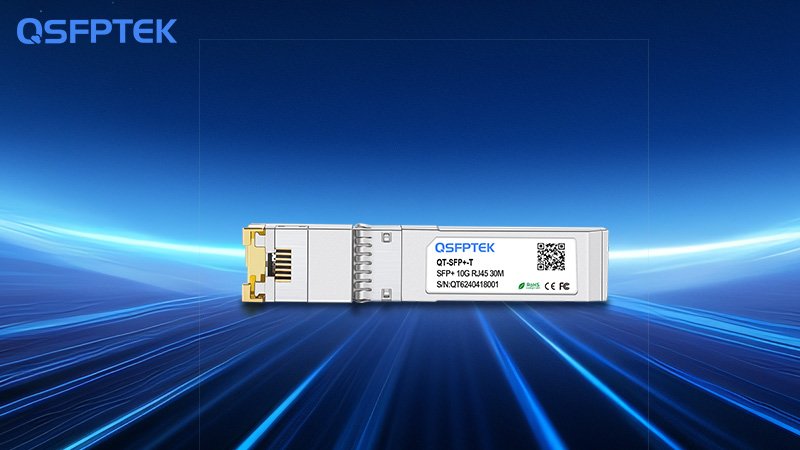
A 10GBASE-T SFP+ copper module is a hot-pluggable transceiver designed to deliver 10 Gigabit Ethernet over twisted-pair copper cables, typically Cat6a or Cat7. It uses an RJ45 connector and supports transmission distances of up to 30 meters, making it an ideal solution for short-range connections such as within racks or between adjacent racks in data centers. This compact transceiver can be inserted directly into SFP+ ports on switches, servers, or network interface cards, enabling 10G performance over the same copper cables that were previously used for 1G connections.
Unlike fiber-based 10G solutions, the 10GBASE-T SFP+ module operates using standard Ethernet signaling, which allows for automatic negotiation between different speeds, including backward compatibility with 1GBASE-T. This feature ensures that network administrators can upgrade equipment in stages, gradually introducing 10G connectivity while maintaining compatibility with existing 1G infrastructure. The module’s plug-and-play design also eliminates the need for fiber termination skills or specialized installation tools, further simplifying deployment.
The Benefits of Simplifying 10G Upgrades
Leveraging Existing Infrastructure
One of the greatest advantages of 10GBASE-T SFP+ copper modules is their ability to utilize existing copper cabling systems. Many enterprise networks already use Cat6a or Cat7 cables for Gigabit Ethernet, which are fully capable of supporting 10GbE over shorter distances. By leveraging the same cabling, businesses can avoid the cost and complexity of installing new fiber infrastructure. This makes the 10GBASE-T SFP+ module an attractive solution for organizations seeking to enhance bandwidth without large-scale physical upgrades.
In addition, the RJ45 interface is universally recognized and widely supported across network equipment from major brands, ensuring broad compatibility. This interoperability allows network administrators to integrate 10G connections into their current setup without worrying about vendor-specific limitations. The result is a faster, smoother transition from 1G to 10G with minimal disruption to daily operations.
Cost-Effective and Practical Deployment
Fiber optic cabling delivers excellent performance for long-distance transmission, but it often comes with higher installation and maintenance costs. Fiber connectors require precision handling and specialized technicians, which can increase labor expenses and deployment time. In contrast, copper cabling is more affordable and easier to manage. The 10GBASE-T SFP+ copper module takes advantage of this by offering high-speed connectivity over cost-effective and familiar media.
Moreover, these modules eliminate the need for optical transceivers and patch cords in short-distance applications, reducing overall expenses while maintaining the same 10GbE speed. For enterprises operating in space-constrained environments such as wiring closets or small data centers, 10G copper modules provide a simple and efficient way to scale network capacity without additional infrastructure investment.
Simplified Management and Compatibility
The backward compatibility of 10GBASE-T technology allows seamless interoperability between new and legacy systems. A 10GBASE-T SFP+ module can automatically adjust to connect with 1GBASE-T devices, meaning that organizations do not need to upgrade all network components simultaneously. This feature enables phased deployment, giving IT teams flexibility to plan upgrades based on budget, workload demands, and future scalability goals.
Additionally, copper connections are easier to test and troubleshoot compared to fiber optics. With standard Ethernet tools and methods, network administrators can quickly identify issues such as cable faults or signal degradation. This simplicity contributes to reduced downtime and maintenance costs, making the management of 10G copper networks more straightforward for IT teams of all sizes.
Application Scenarios in Modern Networks
The 10GBASE-T SFP+ copper module is particularly well-suited for short-distance, high-bandwidth applications commonly found in enterprise and data center environments. Within a data center, it can be used for top-of-rack (ToR) or middle-of-row (MoR) connections, linking servers, storage devices, and switches with minimal cabling complexity. Since the module supports standard RJ45 connectors, it integrates easily with existing copper patch panels and cabling systems, helping maintain a clean and organized rack layout.
In enterprise networks, 10G copper modules are ideal for connecting access switches, high-performance workstations, and backbone aggregation devices. They also provide reliable performance in office environments where flexibility and ease of use are more important than extended transmission distances. For research institutions, small data centers, and edge computing sites, these modules offer a convenient solution to handle increased data traffic without the need for costly infrastructure replacement.
Performance and Energy Considerations
While 10GBASE-T technology is known for its flexibility, it does consume slightly more power compared to optical solutions or direct attach cables (DAC). However, recent advances in chip design have significantly improved power efficiency in modern 10GBASE-T SFP+ modules, reducing energy consumption while maintaining stable performance. The balance between power usage, cost savings, and installation convenience makes these modules especially practical for environments where short-distance, high-speed connections are the norm.
For most enterprises and small to medium-sized data centers, the power trade-off is outweighed by the benefits of simplified installation, lower total cost of ownership, and compatibility with widely available copper cabling infrastructure. As networking equipment continues to evolve, many vendors are developing energy-optimized 10GBASE-T modules that further narrow the efficiency gap with fiber optics.
The Future of 10G Copper Connectivity
As the demand for faster and more efficient networks grows, 10GBASE-T SFP+ copper modules are expected to remain a vital component in enterprise networking. Their combination of high bandwidth, backward compatibility, and ease of deployment makes them a preferred choice for businesses seeking a cost-effective upgrade path to 10GbE. Furthermore, as higher-speed standards like 25G and 40G become mainstream, 10GBASE-T technology will continue to serve as a reliable backbone for many internal and edge network connections.
Conclusion
Upgrading to 10G networks no longer requires complex fiber installations or expensive infrastructure overhauls. With 10GBASE-T SFP+ copper modules, organizations can achieve high-speed Ethernet performance using their existing copper cabling and familiar RJ45 interfaces. These transceivers simplify deployment, reduce costs, and ensure smooth compatibility across mixed-speed environments. As a result, businesses can focus on improving productivity and performance rather than worrying about complicated network upgrades. In the evolving landscape of modern networking, 10G copper SFP+ modules represent the perfect balance between simplicity, performance, and affordability—a smart step forward for any organization embracing the next generation of Ethernet connectivity.