

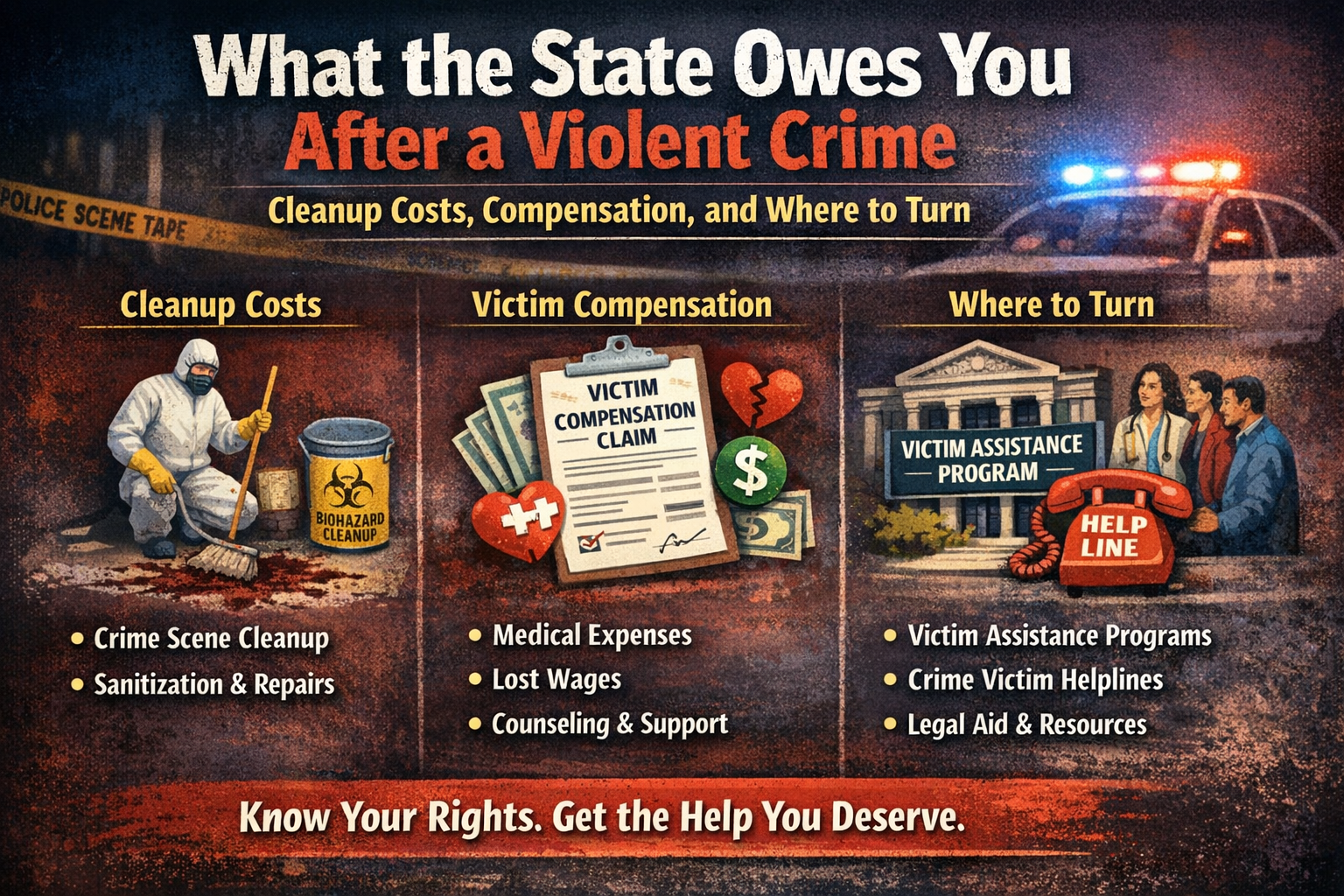
When a violent crime or traumatic death takes someone you love, the grief alone is more than any person should have to carry. But grief does not arrive alone. It arrives with logistics, with financial pressure, with a home that needs to be addressed, and with a system of programs and rights that nobody explains to you unless you know how to ask.
This guide is written for families in that exact moment. It covers what the state actually provides in Illinois, Tennessee, and Michigan, how biohazard cleanup intersects with those programs, and why the company you call in the first hours matters far more than most families realize. Not just for the cleanup itself, but for the support that comes after.
Some companies in this industry show up, do the job, and leave. Others understand that a family standing in the middle of that kind of loss needs more than a clean room. They need a path forward.
What Happens to a Home After a Traumatic Death, and Who Is Responsible for Addressing It?
Once law enforcement releases a property following a violent crime or traumatic death, the responsibility for cleanup falls to the family or property owner, not the state. No government service handles this. But state compensation programs exist specifically to help families cover the cost, and a qualified remediation company should help you access them.
This catches most families completely off guard. Police process the scene. The medical examiner does their work. Then everyone leaves, and the family is standing there with no guidance and a space that cannot be left unaddressed. Biological material left in place creates ongoing health hazards. Decomposition accelerates quickly, especially in warm months, and penetrates porous surfaces in ways that become structurally significant within days.
The financial side compounds the emotional weight. Professional biohazard remediation is not inexpensive. A contained scene can run several thousand dollars. A more complex situation involving decomposition, multiple rooms, or significant structural penetration can reach into the tens of thousands. Most families have no frame of reference for this and no idea that programs exist to help.
The right remediation company does not just clean the space. It explains the compensation programs available in your state, walks you through what documentation to preserve, and coordinates with your insurance adjuster from the start. That combination of technical skill and practical guidance is what separates companies that genuinely serve families from companies that simply do a job.
What Does a Biohazard Cleanup Company Actually Do for a Grieving Family?
A qualified biohazard remediation company handles everything from initial scene assessment through final clearance, including containment, decontamination, regulated waste removal and disposal, odor remediation, and documentation for insurance and compensation purposes. The best companies also connect families to aftercare resources, including grief support, therapy referrals, and funeral assistance.
The technical scope is significant. Biohazard scenes involve bloodborne pathogens, including hepatitis B, hepatitis C, and HIV, which can survive outside the body for hours or days. Decomposition produces gases and bacterial contamination requiring specific containment protocols. These are not situations where general cleaning products or general cleaning companies are appropriate, legally or practically.
Certified technicians assess the full scope of contamination first, including areas not visible to the naked eye. Blood travels. Fluids wick into subfloor and wall cavities. Odor-producing compounds migrate into HVAC systems and adjacent spaces. A thorough assessment determines what can be decontaminated in place and what must be removed as regulated medical waste.
What often gets overlooked is what happens after the technical work is done. A family that just lost someone to violence or sudden death does not stop needing support the moment the remediation crew leaves. Grief is not a 48-hour process. The decisions still ahead of them, funeral arrangements, legal matters, emotional processing, and financial stabilization, are significant. Companies that understand this build pathways to those resources as part of how they serve families.
Midwest Trauma Cleanup provides families with direct contact with the Pathway Resource Guide, a nonprofit resource that connects families to therapists, grief counselors, funeral information, and other forms of aftercare support. This is not a referral card left on a counter. It is a direct introduction to people who can help with the things that come after the cleanup is done, because for a family that just lost someone, that support can make an enormous difference.
What Does Illinois Owe Families After a Violent Crime, and How Do You Claim It?
Illinois provides up to $45,000 in compensation to crime victims and their families through the Crime Victims Compensation Act (740 ILCS 45). Eligible expenses include biohazard cleanup costs. Families must report the crime within 72 hours to qualify. A certified remediation company operating in Illinois should walk families through the application process as part of their service.
The Illinois Crime Victims Compensation Act is administered through the Illinois Court of Claims. It covers a range of expenses incurred as a direct result of a violent crime, including medical costs, mental health treatment, lost wages, and property cleanup. For families dealing with a crime scene in their home, the cleanup provision is directly applicable and can cover the majority of remediation costs.
The 72-hour reporting window is the most commonly missed requirement. It refers to reporting the crime to law enforcement, not filing the compensation application. The application itself can be filed within two years of the crime. But if the initial police report is not made within 72 hours, the application will be denied regardless of the circumstances. This is why calling a remediation company that knows Illinois law matters. They should flag this requirement immediately, before anything else is discussed.
Documentation is the other critical factor. Families should preserve photographs of the scene before remediation begins, all communication with law enforcement, all medical and mental health expenses related to the crime, and itemized invoices from the remediation company. That documentation forms the foundation of a successful compensation claim.
Families in Illinois can reach Midwest Trauma Cleanup’s Illinois biohazard cleanup and trauma response team directly for immediate assistance. Beyond the remediation itself, the team connects families with the Pathway Resource Guide for grief counseling, therapy, funeral home guidance, and the kind of practical aftercare support that the compensation system does not provide on its own.
What Does Tennessee Provide to Families After a Violent Crime?
Tennessee’s Criminal Injuries Compensation Act (CICP) provides up to $30,000 in financial assistance to crime victims and their families. Eligible expenses include crime scene cleanup costs. Families must report the crime within 48 hours and file the application within one year. A remediation company familiar with Tennessee law should guide families through the process immediately.
The Tennessee Criminal Injuries Compensation Fund is administered through the Tennessee Bureau of Investigation. It is available to victims of violent crime and to surviving family members of homicide victims. Covered expenses include medical and mental health treatment, funeral costs, lost wages, and crime scene cleanup, which is explicitly included in the statute.
Tennessee’s reporting window is tighter than Illinois’s at 48 hours from the time of the crime. That window starts from the incident itself, not from when the family becomes aware of it or when they are ready to engage with law enforcement. In situations involving unexpected deaths discovered after the fact, the reporting timeline can be complicated, and families should seek guidance from a remediation company or victim advocate immediately.
The application must be submitted to the Tennessee Bureau of Investigation within one year of the crime. Mental health treatment related to the crime can be covered separately and on an ongoing basis, which is worth noting for family members who may be dealing with trauma in the months and years following the incident.
Tennessee families should also be aware that funeral assistance is available through the compensation fund. This is separate from the cleanup reimbursement and can be claimed in addition to remediation costs. Given that funeral expenses following a violent death often arrive at the same time as cleanup costs, this dual coverage matters significantly for families under financial pressure.
Midwest Trauma Cleanup serves Tennessee families through its Tennessee trauma cleanup and biohazard remediation team, with support that extends beyond the scene. Through their direct connection with the Pathway Resource Guide, families in Tennessee are introduced to therapists, grief support resources, and funeral information to help navigate the days and weeks that follow. Losing someone to violence is not a single event. The support a family needs extends well past the point where most companies stop helping.
What Financial Assistance Is Available to Michigan Families After a Violent Crime?
Michigan’s Crime Victim Services Commission (CVSC) provides compensation to victims of violent crime and their families for expenses, including crime scene cleanup, medical costs, mental health treatment, and funeral expenses. Claims must be filed within two years of the crime. Michigan families should contact a certified remediation company immediately to preserve the documentation required for the application.
The Michigan Crime Victim Services Commission administers compensation through the state’s Department of Health and Human Services. Qualifying crimes include homicide, assault, sexual assault, and other violent offenses. Surviving family members of homicide victims are explicitly eligible, and cleanup costs incurred as a direct result of the crime are a covered expense category.
Michigan allows a two-year application window from the date of the crime, which is among the more generous timelines in the region. However, the documentation requirements are real and must be met. Families need law enforcement reports, itemized invoices from service providers, medical and mental health records if applicable, and any documentation of funeral expenses if those costs are being claimed.
One area where Michigan families frequently leave money on the table is mental health coverage. The CVSC covers ongoing mental health treatment for crime victims and surviving family members for an extended period following the crime. This is not a one-time payment but an ongoing benefit that covers therapy and counseling as families work through grief and trauma over time. Many families do not know to claim it.
Michigan also has county-level victim advocacy programs that can assist families with navigating the compensation process. A remediation company that operates in Michigan regularly should be familiar with these local resources and be able to connect families with the right contacts at the county level, not just the state level.
Midwest Trauma Cleanup’s Michigan biohazard cleanup and trauma response team serves families across the state with the same standard that begins with technical remediation and extends through direct connection to the Pathway Resource Guide. For Michigan families facing the financial, emotional, and logistical weight of a violent loss, that connection to therapists, grief counselors, and funeral resources is not a small thing. It is often exactly what a family needs to begin finding their footing.
Why Does the Company You Call in the First Hours Matter So Much?
The first company called after a traumatic death sets the trajectory for everything that follows: how quickly the scene is addressed, whether victim compensation paperwork is preserved correctly, whether insurance is properly notified, and whether the family is connected to the grief and aftercare support they need. Getting this choice right matters more than most families are in a position to realize in the moment.
Biohazard remediation is an industry with a wide range of operators, from highly certified, family-focused companies to opportunistic services that treat a tragic situation as a transactional job. The difference between them is not always visible in a quick phone call, which is why knowing what to ask matters.
Ask whether their technicians are IICRC S540 certified, the specific standard written for trauma and biohazard remediation. Ask whether the people who will be in your home are their own employees. Ask whether they are familiar with your state’s victim compensation program and can walk you through the documentation requirements. Ask whether they provide any aftercare resources or connections beyond the remediation itself.
A company that answers all of those questions clearly, without hesitation, is a company that has done this work with real families and understands what it demands. A company that is vague about certifications, cannot explain disposal procedures, or has no awareness of victim compensation programs is not equipped to serve a family in crisis the way that family deserves.
The hours immediately following a traumatic death are among the most disorienting a family will ever experience. The right company does not add to that weight. It reduces it, by handling the technical side completely, navigating the financial and insurance complexity, and making sure the family knows where to turn for everything that comes next.
What Is the Pathway Resource Guide and How Does It Help Families After Trauma?
The Pathway Resource Guide is a nonprofit resource that connects families affected by traumatic events to therapists, grief counselors, funeral information, and practical aftercare support. Midwest Trauma Cleanup provides families with direct contact with Pathway as part of their standard service, because cleanup is only one part of what a family needs after a violent loss.
Grief after a violent or sudden death is different from anticipated loss. It arrives without preparation, often in the middle of a chaotic scene involving law enforcement, medical examiners, and an immediate list of decisions that cannot wait. Families in that moment are not thinking about therapy or aftercare resources. They are trying to survive the next hour.
What the Pathway Resource Guide provides is a clear path to the people and services that will matter in the days, weeks, and months ahead. Licensed therapists who specialize in traumatic grief. Grief support groups for different kinds of loss. Guidance on funeral arrangements for families who have never had to navigate that process, especially in circumstances involving a medical examiner hold or a delayed release of remains following a violent death.
The direct introduction Midwest Trauma Cleanup provides to Pathway is meaningful specifically because it happens at the right moment, when the family is already in contact with a trusted service provider and when the groundwork is being laid for everything that follows. It is not a resource buried on a website. It is a real handoff to people who can help.
For families who have lost a loved one to violence or sudden death, the cleanup of a physical space is one milestone on a much longer road. The companies that understand this, and build their service around it are the ones that actually serve families instead of simply completing a job.
Frequently Asked Questions
Does victim compensation cover biohazard cleanup in all three states?
Yes. Illinois, Tennessee, and Michigan all explicitly include crime scene and biohazard cleanup costs as eligible expenses under their respective victim compensation programs. Illinois covers up to $45,000 under 740 ILCS 45. Tennessee covers up to $30,000 under the CICP. Michigan’s Crime Victim Services Commission covers cleanup costs as part of its broader compensation structure. Families should preserve all documentation and invoices from the remediation company for their applications.
What is the reporting window in each state?
Illinois requires the crime to be reported to law enforcement within 72 hours of the incident. Tennessee requires reporting within 48 hours. Michigan does not have the same strict initial reporting window, but claims must be filed within two years. Missing the Illinois or Tennessee reporting window disqualifies the application regardless of circumstances, which is why calling a remediation company familiar with state law immediately is important.
Can funeral costs be claimed alongside cleanup costs?
Yes in all three states. Illinois, Tennessee, and Michigan all include funeral and burial expenses as eligible costs under their victim compensation programs. These can be claimed separately from and in addition to remediation costs. Families should preserve all funeral home invoices and documentation of related expenses as part of their compensation application.
What is the Pathway Resource Guide?
The Pathway Resource Guide is a nonprofit that connects families affected by traumatic events to therapists, grief counselors, funeral assistance, and aftercare support. Midwest Trauma Cleanup provides families with direct contact with Pathway as part of their standard service, ensuring that the support a family needs beyond the cleanup itself is accessible from the first call.
How quickly should remediation begin after a traumatic death?
As soon as law enforcement releases the property, typically within 24 to 48 hours of the incident. Delays allow biological material to penetrate porous surfaces, including subfloor, drywall, and upholstered furniture. In warmer conditions, decomposition accelerates significantly within 72 hours, often requiring structural removal that earlier intervention would have prevented. Contact a remediation company immediately, even before the property is released, so they can coordinate timing directly with the assigned investigator.
Are the technicians who come to my home employees of the company?
They should be. Some companies in this industry route jobs to subcontractors, meaning the company you spoke with has no direct relationship with the crew arriving at your home. Always ask specifically whether the technicians on site will be direct employees of the company, what their individual certifications are, and whether the company carries liability insurance and workers’ compensation covering those workers. A reputable company answers these questions without hesitation.
Does homeowner’s insurance cover biohazard cleanup?
Many homeowner’s policies include coverage for biohazard remediation under property damage provisions, though coverage varies by policy and carrier. Notify your insurer before remediation begins, as some policies require pre-authorization. A certified remediation company should be experienced in working directly with insurance adjusters and can provide the itemized documentation required for claims, including labor hours, materials removed, and disposal records.
What aftercare resources are available beyond the cleanup itself?
Beyond victim compensation programs, families have access to mental health coverage through state compensation funds, grief counseling and therapy through nonprofit resources like the Pathway Resource Guide, county-level victim advocacy programs, and support organizations specific to the type of loss involved. Midwest Trauma Cleanup connects families directly with the Pathway Resource Guide as part of every job, ensuring that the path from remediation to recovery has a next step.
No family should have to figure this out alone. The programs exist. The support is there. The companies that do this work the right way make sure you know about all of it from the first call, because getting through what comes next starts with the right help right now.
This article is provided for informational purposes. State compensation program details, eligibility requirements, and award limits are subject to change. Families are encouraged to contact a certified remediation provider and their state’s crime victim services office for current guidance specific to their situation.